Web apps and AI for businesses in Tanzania: where they actually help
How custom web apps and AI help Tanzanian businesses, from Zoho quote storefronts to Swahili customer assistants, and how to get a quote.
In this post
A custom web application is software that runs in your browser and does part of your business's work for you: a dashboard, a client portal, a storefront that sends quote requests straight into Zoho, or a tool that turns hours of typing into seconds. AI adds the jobs that used to need a person to read or reply, like answering customer questions in English and Swahili or pulling the details off a pile of receipts. For most businesses in Tanzania, the best place to start is simple: the one job that eats the most hours every week.
Here's what that looks like in practice. A lot of businesses here run on the same three things: an Excel file that only one person really understands, a WhatsApp group where orders and questions pile up, and a long night at the end of every month when somebody types receipts into the accounts. It works. Then the business grows a little, and those same three things start eating whole days.
I'm Jay Shivram, and I run JS Solutions, a web design and development business in Dar es Salaam. Alongside websites, I now build custom web applications and AI tools for businesses. I specialise in full-stack web development and IT outsourcing: web apps in React, Node.js and Next.js, desktop and mobile apps built with Electron, Tauri and Capacitor, and AI and machine learning solutions. This post is about where they genuinely help, where they don't, and how to tell whether your business needs one.
What's the difference between a website and a web app?
A website tells people about your business. It's your shop window: who you are, what you sell, how to reach you.
A web application does part of the work. You log in, type or upload something, and it hands you back a result: a statement, a report, a list of who still owes you money, a form filled in and ready to print. It runs in the browser, so it works on a phone, a tablet or a computer without anyone installing anything.
You already use plenty of them without thinking about it. Online banking is a web app. So is the portal where you file your returns. The difference with a custom one is that it's built around how your business does things, not around how a software company in another country assumes you work.
Signs your business has outgrown its spreadsheets
None of these mean something is wrong. They mean the business has grown past the tools it started with.
- The same information gets typed twice. Once on paper, then into Excel, then again into the accounting system.
- One person holds it all together. If they're off sick, nobody knows where the latest figures are.
- Month-end takes days. Statements, receipts, reconciliations and reports, all by hand, every single month.
- Customers ask the same questions all day. Prices, opening hours, whether something is in stock, how to pay.
- You pay for software that almost fits, and your team works around the parts that don't.
- Simple questions take an afternoon. Which customer owes the most? What sold best last month? Nobody can say without digging.
If two or three of those sound familiar, it's worth a conversation.

Three tools I built, and the boring jobs behind them
I'm also a practising accountant, so I know month-end from the inside. Some of the first tools I built were for jobs I watched eat hours every month. They're all on the work page if you want to see them.
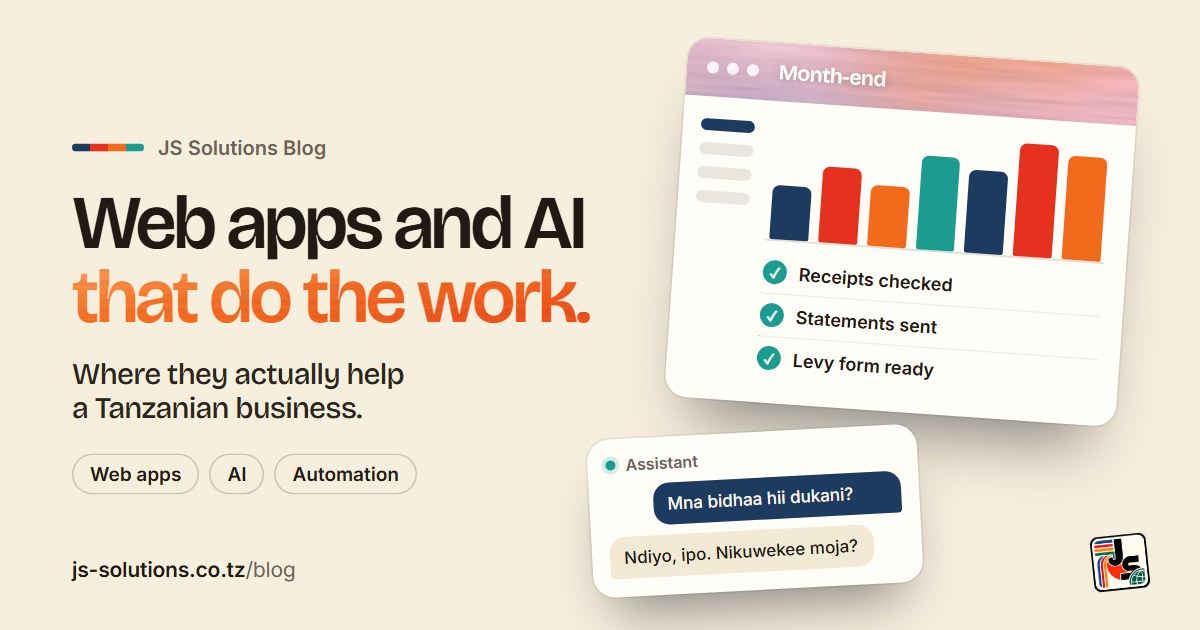
EFD Verify reads a TRA receipts report, checks every EFD receipt, catches the duplicates, and writes the ledgers straight into TallyPrime. A month-end typing job becomes a few seconds of processing. (It's an independent tool, not affiliated with or endorsed by the Tanzania Revenue Authority.)
LedgerRun talks to TallyPrime directly and produces a statement of account for every ledger in a group, laid out exactly like Tally's own. It has run 182 ledgers in one go in under twenty seconds, and no figures leave the machine.
Levy Desk fills in the City Service Levy forms for Temeke, Kinondoni and Ilala. You type the monthly turnover, and it works out the totals, the arrears and the 0.25% levy, then prints the council form laid out like the original. English or Kiswahili, and no sign-up. (Also independent, and not affiliated with the councils.)
To be accurate, the first two are desktop tools, because they talk to TallyPrime on the computer it's installed on. Levy Desk runs in the browser. The idea behind all three is the same, though. None of them is clever for the sake of it. Each one takes a job a person used to do slowly and carefully, and does it in seconds, the same way every time. Most of the time, that's what good business software looks like.
What kind of web app does a business need?
- A dashboard. One screen with the numbers your team actually works from: sales, stock, unpaid invoices, jobs in progress.
- A client portal. A place where your clients log in to see their own documents, orders, bookings or statements, instead of asking you to send them again.
- An internal tool. Bookings, job tracking, stock moving between branches, staff requests. Whatever your team does today on paper or in a WhatsApp group.
- An upgrade to what you already have. Getting two systems to talk to each other, or rebuilding an old tool the business has outgrown.
Can I put my catalogue online without showing my prices?
Yes, and for a lot of distributors, wholesalers and suppliers here, this is the web app that pays for itself first.
Here's the problem. Your price list is your edge. You've negotiated it with suppliers over years, and different customers get different prices. Put it on a public website and your competitors have it by lunchtime. So most businesses keep the catalogue offline too, and customers end up sending a photo of a product on WhatsApp and asking "how much?", while someone on your team digs out the spec sheet and types up a quote by hand.
If you already run your business on Zoho (Zoho Books, Zoho Inventory or the CRM), a custom storefront can sit on top of it:
- Your catalogue goes online, straight from Zoho. Product names, photos, descriptions and datasheets, kept up to date from the system you already use, so nobody maintains two lists.
- Customers build a quote request instead of a cart. They browse, pick what they need, enter quantities and send it. No prices on show anywhere.
- The request lands in Zoho, ready for you. It can arrive as a draft estimate with the customer and items already filled in. Your team checks it, sets the price for that customer, and sends a proper quote from Zoho, the way you do today.
- Your trade customers can get their own view. If you want, the customers you approve can log in to see their past quotes, reorder, or check whether something is in stock, without anyone else seeing the same.
The prices that make you competitive stay private. The customer gets a smooth, professional way to ask, at any hour. And your team stops retyping the same product details into quotes all day, which is exactly the kind of quiet change that keeps a business growing without the stress growing with it.
The same idea works with other systems too, as long as they can share their data. Zoho is simply the one I see most often.
JS Solutions can set this up for you. I connect the storefront to the Zoho account you already have, match it to how your team quotes today, and test it with your real products and customers before it goes live. You keep working in Zoho the way you always have; the quote requests simply start arriving there on their own, and it all runs smoothly in the background. Tell me how you use Zoho today and I'll come back with a written quote.

How can AI help a business in Tanzania?
AI is everywhere at the moment, and a fair amount of what gets sold as AI is a gimmick. In a real business it's most useful when it does one specific job well. These are the ones I see making sense for businesses here.
Answering customer questions. If your staff spend the day replying to the same messages, an assistant on your website can answer them from your own information: your prices, opening hours, delivery areas and policies. It can be set up to reply in English and Swahili, so customers use whichever they're comfortable with. And when it doesn't know something, it should say so and pass the customer to a person.
Reading documents so nobody has to type them. Receipts, invoices, delivery notes, application forms. AI can pull out the details (the supplier, the date, the amount, the TIN) and put them where they belong. Someone still checks the result, but checking is a lot faster than typing.
Getting routine work ready. The weekly sales summary, a first draft of the reply to a common complaint, a polite reminder to customers who haven't paid. Work that follows a pattern can be waiting for you when you get in.
Inside a web app. Search that understands what you meant, not only the exact word you typed. A short summary at the top of a long report. Suggestions based on your own records.

When is AI the wrong answer?
I'd rather turn a project down than build something that doesn't earn its keep. So, a few honest points:
- If the process is a mess, AI just makes a faster mess. Sometimes the real fix is a simple form and a clear way of working, and that costs less.
- It gets things wrong sometimes. Anything that touches money, tax or a customer's account needs a person checking it, at least until you've learned to trust it. A good AI tool is built with that check in mind from the start.
- It costs money to run, not only to build. Most AI services charge for the work they do, so a sensible quote should tell you roughly what it will cost each month, as well as what it costs to build.
- Your data matters. Customer records and financial figures need care about where they end up. Some jobs are better done by a tool that keeps everything on your own computer, the way LedgerRun does.
Quite often the right answer is "you don't need AI for this, you need a small web app", or even "you need a better website first". If that's the honest answer, that's the one you'll get.
How much does a custom web app or AI project cost?
There's no fixed price for web apps or AI work, because no two are alike. A booking tool for a clinic in Masaki and a stock system for a wholesaler in Kariakoo are completely different jobs. So every project is quoted on scope, from your requirements. Here's how it runs:
- You send your requirements. A rough list is fine. There's a short guide to what to include below.
- I ask about anything that's missing, then send you a written scope, quote and timeline. Nothing starts until you've agreed to it.
- It's built in stages you can see. You test it along the way with real examples from your own work, so nothing comes as a surprise at the end.
- Handover. You get a walkthrough of how everything works, and once the project is paid for, the application and its code are handed over in your name.
It all happens over calls, WhatsApp and email, in English or Swahili. If you're in Arusha, Zanzibar or Morogoro, or outside Tanzania altogether, it works exactly the same way.

What to put in your message
You don't need a technical document. Just answer these in your own words:
- What's the problem? What takes too long, keeps going wrong, or depends on one person?
- Who will use it, and how many people? Your team, your customers, or both?
- What does it need to do, step by step? Walk me through how the job gets done today.
- What does it have to work with? Zoho, TallyPrime, Excel files, your existing website, or anything else you already use.
- When do you need it?
A photo of the spreadsheet or paper form you use today helps more than you'd think.
Ready when you are
Send me your requirements through the contact page or on WhatsApp, and I'll come back to you with a written quote. If you'd like to read a bit more first, there's a page on custom web applications and one on AI solutions.
And if what you need right now is a website, that's still the core of what I do. There's a guide to what a website costs in Tanzania, and the packages are on the pricing page.

Written by
Jay Shivram
Founder of JS Solutions, a web design and development business based in Dar es Salaam, Tanzania.