Outsourcing web development in Tanzania: why it often beats hiring
Hiring a developer means a salary all year for work that comes in bursts. Why outsourcing your website or web app often makes more sense, and how to do it well, from a developer in Dar es Salaam.
In this post
If your business needs a website, a web app or changes every now and then, outsourcing the work is usually a better deal than hiring a developer. You pay when there's work to do. You get someone who has built that kind of thing before. And you skip months of recruiting for a skill you probably can't judge. For agencies, it means you can say yes to the next client even when your own team is full.
I'm Jay Shivram. I run JS Solutions, a web design and development business in Dar es Salaam, and outsourced work is part of what I do. So yes, I have an interest here. I've tried to be fair anyway, and there's a section further down on when hiring is the right call.
One thing first. If you search for outsourcing in Tanzania, most of what comes up is about staff: HR firms, payroll, call centres. This post is only about web work. Websites, web apps and AI tools.
The trouble with hiring a developer
Picture a company in Dar es Salaam that needs a new website. Someone in a meeting says, "Why don't we just hire a developer?" It sounds sensible. Here's what tends to happen next.
The hiring takes a while. There's a job advert, a pile of CVs, then interviews for a skill nobody in the room can really test. Most business owners can't tell a strong developer from a weak one by talking to them, and a CV doesn't tell you much either. Weeks go by before anyone builds anything.
Then there's the cost. A developer on staff gets paid every month, busy or not. On top of the salary you've got NSSF, WCF and, depending on your size, SDL, plus a computer, software, and someone to manage them. I'm an accountant as well, so this is the part I always notice first.
Then the work dries up. A website is a few weeks of real work, then small changes now and again. A full-time developer with nothing to build either gets bored and leaves, or ends up doing other jobs that aren't what you hired them for.
One person rarely covers it all, either. A good site needs design, the build itself, being found on Google, and someone keeping an eye on hosting and updates afterwards. Those are different skills. Hire one person and you'll usually get one of them done well.
And when that person leaves, a lot can leave with them: the passwords, the code, and the reasons things were done a certain way. Unless somebody wrote it all down, the next person starts by working out what the last one did.

What changes when you outsource
You describe what you need, and you agree the scope and the price before any work starts. Then someone who builds this kind of thing for a living gets on with it.
You're paying for a project, not a salary. Once the site is live, the cost stops. If you want changes later, you pay for those, or for a monthly care plan if you'd rather not think about it.
There's no recruitment round. You send a brief, and the next thing you get is a written quote.
You judge the work instead of the interview. Rather than guessing from a CV, you open sites they've already built, on your own phone, and see for yourself.
And it's yours. A proper arrangement hands over the code, the domain and the hosting in your name, so nobody can walk off with them.
Agencies get the same problem from the other side
If you run a marketing, branding or digital agency, you'll know this one. A client wants a website, your developers are already on two other jobs, and hiring someone for a single project makes no sense. So you turn the work down, or you squeeze it in and everything else runs late.
Outsourcing gives you a third option. You keep the client, and the build goes to someone outside. It can be white-label, which means the site goes out under your agency's name. Your client keeps dealing with you, like always.

Why outsource to Dar es Salaam?
If you're in Tanzania, it comes down to knowing your customers. Most of them browse on a phone, a lot of them on patchy connections, and plenty of business here starts on WhatsApp. A site built with that in mind does better than one built for a fast laptop in an office somewhere else.
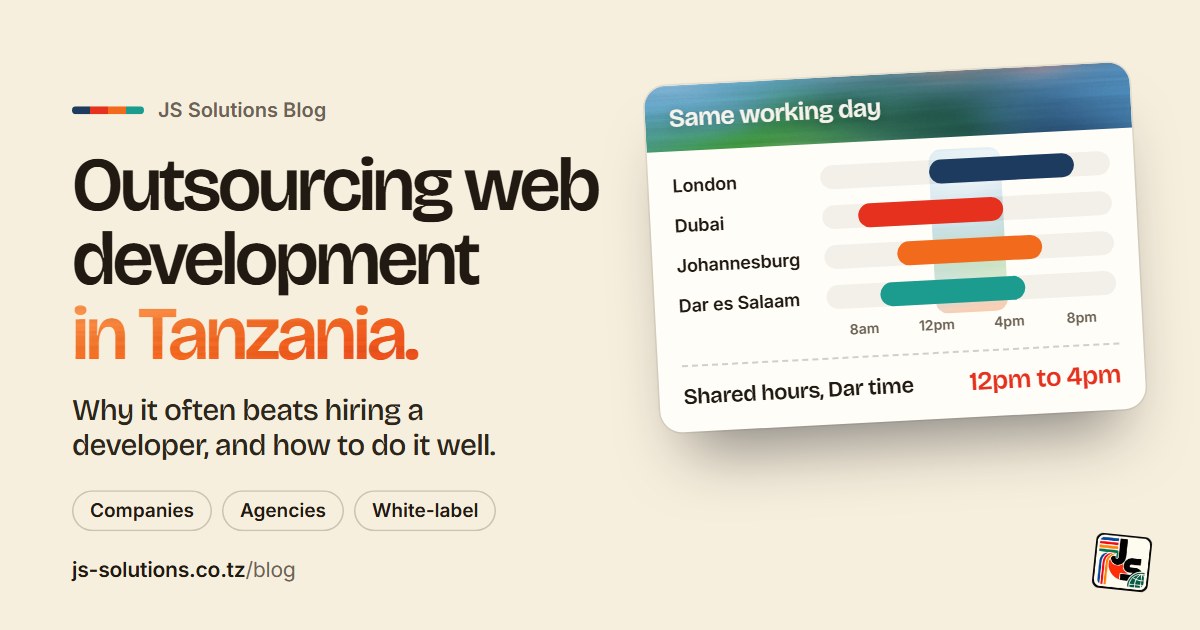
If you're outside Tanzania, the time zone matters more than the distance. Tanzania is on East Africa Time, three hours ahead of UTC, and the clocks never change. A 9 to 5 day in London runs from midday to 8 in the evening here in the UK winter, and from 11 to 7 in the UK summer. Dubai is an hour ahead of us and Johannesburg an hour behind. That leaves most of your working day with both of us at our desks.
I work in English and Swahili. Briefs and calls in English are completely normal, and if your customers are in East Africa, the site can talk to them in Swahili too. My prices are set in Tanzanian shillings and shown converted for clients abroad, with nothing added for being outside the country.

When hiring is still the better choice
I'd be lying if I said outsourcing always wins. Hire someone if the software is your product and it changes every week. Hire if you need a person in the office every day for lots of small things, or if there's so much constant work that a salary costs less than any quote would.
Plenty of businesses end up doing both: one person inside who knows the business well, and outside help for the bigger builds.
For most businesses, though, none of that applies. They need a good website, maybe one tool that saves their team a few hours a week, and someone reliable to call when something needs changing. That's what outsourcing is for.
What you can hand over
Anything on the web side. I specialise in full-stack web development and IT outsourcing: websites and web apps in React, Node.js and Next.js, desktop and mobile apps built with Electron, Tauri and Capacitor, and AI and machine learning solutions. With me, that means:
- Websites, from a single landing page to a full multi-page site. See website development.
- Web applications, like dashboards, client portals, and tools that take a slow manual job off your team. See web applications.
- Desktop and mobile apps, built with Electron, Tauri or Capacitor.
- AI features, such as an assistant that answers customers in English and Swahili, or a tool that reads receipts and invoices. See AI solutions.
- Design on its own, if you've got developers but no designer. See web design and UI/UX.
- Redesigns, SEO and maintenance for sites that already exist. See redesign, SEO and maintenance.
What I don't take on is outsourced accounting, HR or call centre work. I am a practising accountant, but that's a separate service, and only for businesses in Dar es Salaam city centre.
How it works with me
- You send the brief: what needs building, who it's for, any designs or brand files you already have, and when you need it.
- I ask about anything that's missing, then send you a written scope, quote and timeline. If you need an NDA before sharing details, send it along with the brief.
- I build it in stages you can see. You (or your client) test it along the way, so the last day holds no surprises.
- Once the work is paid for, the code, the files and any accounts are handed over to you or your client.
If you're an agency, the work can be white-label, so your client only ever sees your name. And if you'd rather not quote every job separately, you can keep me on each month instead, agreed up front.
All of it runs over calls, email and WhatsApp, or in whatever tools your team already uses.

Before you outsource to anyone
Whoever you pick, here or anywhere else, ask these before you pay a deposit:
- Can I see live work? Not mock-ups, but real sites you can open on your phone. Mine are on the work page.
- Who actually does the work? Some firms pass jobs on to someone you'll never meet.
- Will I get a written scope and quote? If it isn't written down, assume it isn't included.
- Who owns the code, the domain and the hosting? It should be you or your client, and it should say so before work starts.
- How will we talk, and when? Agree on the channel and the hours early.
- What happens after launch? Find out how fixes and changes are handled once the site is live.
- Is the business real? Check that it's registered and that its contact details match across its website and profiles.
Someone worth working with will answer all of these without a second thought.
What to send me
You don't need a technical document. A short message covering these is plenty:
- What needs doing: a new site, a web app, a redesign, design only, or ongoing help.
- Who it's for: your own business, or an agency client (and whether it should be white-label).
- What already exists: designs, a brand guide, content, an old site or system.
- What it has to work with, like Zoho, TallyPrime, a payment provider or an existing website.
- When you need it, and whether there's a fixed launch date.
Links to two or three sites you like will help more than you'd think.
Ready when you are
If you're a company without a developer, or an agency with more work than hands, take a look at the outsourcing page, then send me your brief on WhatsApp or by email, in English or Swahili. You'll get a straight answer on scope, price and timing before anything starts.

Written by
Jay Shivram
Founder of JS Solutions, a web design and development business based in Dar es Salaam, Tanzania.